Here's a quick story about one of our practices to encourage engagement through structured self-organization for our agile software development teams.
Why Structure Is Important in a Self-Organizing Agile Environment
Like many aspects of
agile software development, there are different interpretations of some of the practices that are espoused, especially by novices. In particular, we tend to encourage team members to volunteer for work versus being "signed up" for it by, in days of yore, a manager. Some times this is taken to an extreme, and team members may not sign up for any work, or sign up for work that is currently not a high priority. This can be problematic as it leaves holes in work that must be done. Therefore, some level of structure is required to get the highest priority (and hopefully valuable) work to be done. This includes the necessary collaborative meetings that, with appropriate engagement, can be phenomenally productive.
An Example: The Rules of "Engagement"
Last year, I came up with a simple list of rules for our larger team meetings to encourage participants to focus on the
goal and to eliminate wasted time (
muda). This was in response to complaints from the team that larger meetings (backlog prioritization, release planning, sprint planning, etc.) were "painful" due to the propensity to get off track and only be interesting to a few participants at a time. Key symptoms included heads bobbing behind laptops, bent heads staring down at what we
hoped were the individuals' smart phones, and the standard response of "huh?" when an opinion was solicited of a team member in either of the two former states. The rules were designed to create a system where the team could feel comfortable holding themselves, each other, and their manager accountable to achieve the stated goal and maximize the value obtained by all participants. I refer to these as the "Rules of Engagement," pictured below.
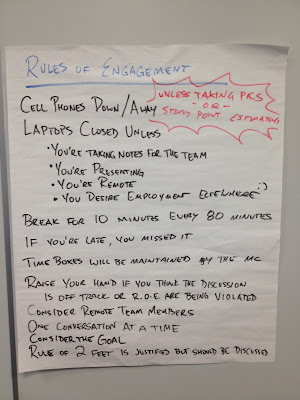 |
| Rules of "Engagement" Poster Used in our Larger Planning Meetings |
The ultimate rule, dubbed "The Rule of Two Feet", was repurposed from the
Open Space Law of Two Feet, whi
ch states: "
If at any time during our time together you find yourself in any situation where you are neither learning nor contributing, use your two feet, go someplace else." This would be the ultimate solution to disengagement, but I thought it made sense to have the departing team member discuss why they were leaving with the rest of the team. In this system, team members are empowered with the flexibility to leave if they feel the content is
off-topic, does not apply to them, or any other reason. However, it
encourages potential continuous improvement (
kaizen) moments, including the discontinuation of practices that no longer serve the team.
Team Response to the Rules of "Engagement"
These rules have been put to the test on a few occasions and resulted in the deprecation of a release planning ritual that seemed to work and had been a standard for the team. One team member was fairly frustrated with this
process and stood up to leave but gave his feedback first. We then went on to have an open dialog in front of the rest of the team. This led to
a much richer discussion about what we were trying to accomplish and the best
way to do it, which continued beyond the original meeting. While the goal had not changed, we learned a more effective way to get there by discontinuing the process, thereby eliminating wasted time. I feel that if the initial team member had
just walked out, we would have missed that critical kaizen moment.
This is certainly a success story, but it worked within a
larger framework of trust that we had developed over close to three years of working
together. As with most practices, your mileage may vary.
Our Standard Rules of "Engagement"
We at CA Technologies host a bevy of Agile Austin meetings, and the poster above tends to be an item of interest. In fact, many visitors have taken pictures of it and brought it back to their teams. This is great, but it's important that everyone understand the context in which it was developed. It is critical that the team buy into this for specific reasons, understanding the why. Like other standards, rules, process, etc., the team needs to be free to change them as they see fit when there are new kaizen moments.
Here's a transcription in case my writing is hard to decipher:
- Cell phones down / away (unless taking pictures of story point estimation)
- Laptops closed unless
- You're taking notes for the team
- You're presenting
- You're remote
- You desire employment elsewhere :)
- Break for 10 minutes every 80 minutes
- If you're late, you missed it
- Time boxes will be maintained by the MC
- Raise your hand if you think the discussion is off-track or the Rules of "Engagement" are being violated
- Consider remote team members
- One conversation at a time
- Consider the goal of the meeting
- "Rule of 2 feet" is justified, but should be discussed
An Aside - Freedom and Organization
Many organizations have unpaid volunteers (local political campaigns, open source software projects, Agile Austin, etc.) but that does not imply that everyone is free to do whatever they would like. There is a mission or a purpose that drives the most effective organization. As the definition of "organization" is: "The structure or arrangement of related or connected items," organization implies structure. Generally, people come in as novices, learn the system and then are entrusted with some span of control beyond themselves once they have attained some level of mastery. It's naive to believe that volunteering is equivalent to the ability to do whatever one desires in any type of complex organization. I see the same thing in organizations trying to create software.
Allowing for self-organization and self-management is essential for software development teams where agility is critical. Indeed, it creates an environment where team members are fully engaged in creating usable and valuable software. However, self-direction may lead away from the goal of the organization. Striking that balance is something that no "best-practice" can ever dictate--indeed it requires experience and a deep understanding of many dynamics. For those in entrusted with managerial or technical leadership positions, this can be an area of extreme benefit or dismay and thus should be a focused area of learning.

